

Let’s Start With a Quick History Lesson
(Don’t Worry, It’s Not Boring)
Once upon a time, just a couple of centuries ago, governments realized they were broke. Wars weren’t going to pay for themselves, so they reached into the old playbook of control: take from the people’s pockets. That’s when they invented income tax.
Britain kicked things off in 1799 to fund their little tantrum with Napoleon. The U.S. made it permanent in 1913, the same year they birthed the Federal Reserve. Coincidence? Of course not.
Fast forward to now, and income tax is no longer just a revenue stream, it’s a religion. A sacred cow. A moral duty. A badge of civilization.
Except… here’s a uncomfortable little thought:
What if income tax isn’t civic responsibility at all? What if it’s just legalized extortion, sold as patriotism?
Let’s take a moment and think of the following actual life scenarios.
Two Families. Same Income. Same Extortion.
Meet Family A: Two adults. No kids. Quiet apartment. Netflix and oat milk.
Now meet Family B: Two adults. Six kids. A minivan held together by duct tape and desperation. Medical bills, diapers, school lunches, the full chaos package.
Both families earn $60,000 a year. Guess what?
They pay the same income tax.
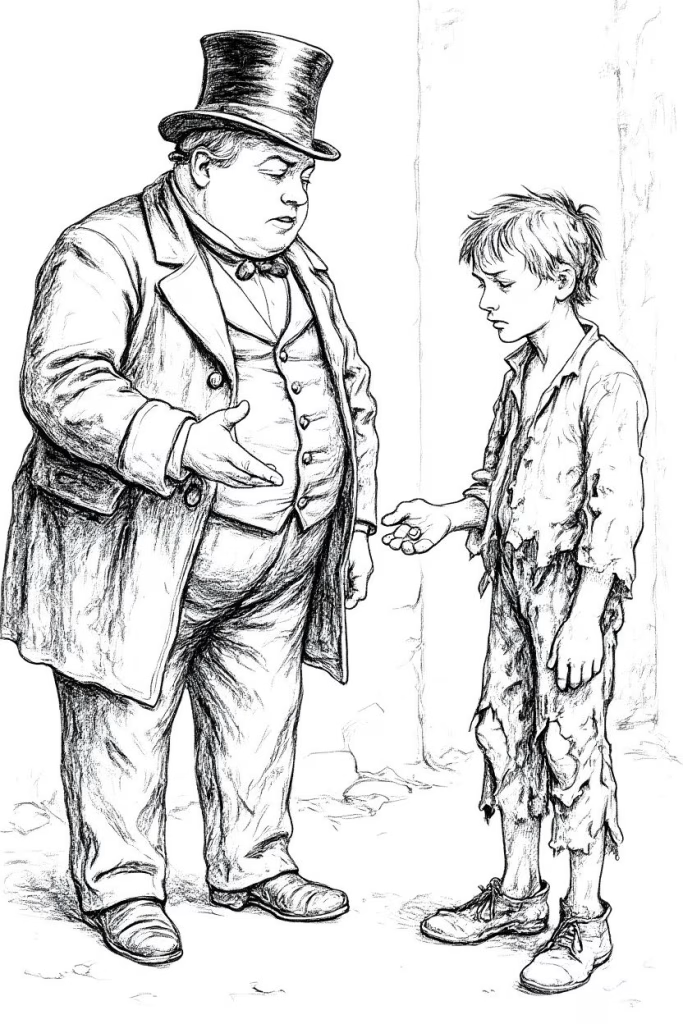
Because the system doesn’t care if you’re feeding eight mouths or just your ego. It doesn’t adjust for illness, debt, or disaster. The taxman doesn’t ask questions. He just knocks.
And that’s the thing about extortion. It doesn’t care. It’s blind, ruthless, and shameless.
But Wait. It Gets Juicier. Corporations Get a Pass
Let’s say you’re a regular person. You work, you earn money. The government shows up and says, “Nice job, hand it over.” End of story.
Now picture a company.
It makes money, subtracts every latte, laptop, and “business strategy retreat” in Bali, then pays tax on whatever’s left. That’s called profit.
Individuals get taxed just for trying to survive. Corporations get taxed on leftovers.
You’re punished for working. They’re rewarded for playing the game.
The Taxman Always Wins. Unless You Can Structure Your Wealth.
Listen to this,
Teacher: If income tax is 20% and your dad earns $50,000, how much tax does he pay?
Kid: $100Teacher: Let’s try again. If income tax is 30% and your dad earns $100,000?
Kid: $100Teacher: Okay, last try. If income tax is 50% and your dad earns $1,000,000?
Kid: $100Teacher: You don’t know your percentages.
Kid: You don’t know my dad.
Funny? Sure. But also depressingly true.
The richer you are, the easier it is to dance [Legally] around the rules. Trusts. Shell corps. Offshore accounts. Legal gymnastics. For the rich and wealthy, taxation isn’t obligation, it’s a puzzle. And they’re solving it just fine.
For the rest of us? It’s relentless extraction, getting absolutely fleeced.
Zakat: The Ethical Wealth Model
Let’s shift to something that isn’t rigged.
Zakat. An ancient Islamic system of redistribution that’s been around for over a thousand years and still makes more sense than anything we’ve conjured up in our boardrooms or parliaments.
Here’s how it works:
- You only pay if you have excess wealth sitting idle for a year.
- It’s just 2.5%, not of your income, but of your actual surplus.
- If you’re broke, in debt, or struggling? You owe nothing. Zero. Nada.
Zakat taxes wealth, not survival. Compassion, not coercion.
It’s the opposite of extortion. It’s redistribution with a conscience.
Why Don’t We Do This?
Because extortion is easier to manage than empathy.
The tax system isn’t built on fairness. It’s built on obedience. It doesn’t care if you’re drowning in debt, grieving a loss, or heating your house with candles. It wants its cut, and it’ll take it, even if there’s blood in the water.
Zakat says, “Keep your money. You need it more.”
The state says, “Pay up, or we’ll garnish your wages and freeze your bank account.”
One system empowers.
The other exploits.
So Here’s the Flip
Start asking the questions no one wants answered:
- Why do we tax income instead of idle wealth?
- Why do we penalize people for trying to get ahead?
- Why do corporations get loopholes while single parents get audited?
- Why are we pretending income tax is moral?
It’s not. It never was. And deep down, we all know it.
The Future of Fair Taxation Isn’t New. It’s Forgotten
Zakat doesn’t need a rebrand.
Income tax did, and it got one.
It was never about fairness. It was always about control.
Zakat:
- Only taxes surplus wealth.
- Protects the vulnerable.
- Circulates money ethically.
Income tax:
- Punishes productivity.
- Ignores context.
- Keeps power at the top.
So maybe it’s time to stop sugarcoating a system that was never designed to serve us.
Maybe it’s time we stop calling it “income tax”… and start calling it what it is: extortion, rebranded.